
Whenever I’m asked about why EurekAlert! is a valuable tool for public information officers (PIOs), the first thing I mention is the tip sheet service. This unique service enables publishers to notify EurekAlert!-registered PIOs about accepted and forthcoming research papers and other newsworthy information involving scientists from their organizations.
It’s an excellent way for institutional PIOs to know in advance about upcoming research by their scientists and equip them with all the details they need to prepare and conduct media outreach and potentially garner earned coverage and maximize scholarly impact. And the best part: it’s available to every PIO with a free EurekAlert! membership.
If we think of a research article as a piece of content that goes on a journey, the first step in that journey post-publication is making the relevant people – e.g., authors and their institution’s PIOs – aware that an article is due to publish soon. EurekAlert!’s tip sheet service is a unique way to achieve this first step, powered by our relationships with several prolific journal publishers and large database of member organizations and PIOs.

For its straightforward purpose, however, the tip sheet service operates on some complex underpinnings that can sometimes make things confusing to navigate. Join me behind the scenes for a clearer picture of how tip sheet data makes its way onto the platform and into the email inboxes of PIOs.
How it works
The tip sheet service features data provided by publishers – usually in the form of an XML file – related to research papers and other journal content either accepted or scheduled for publication in an upcoming online or print issue. In essence, it’s a table of contents — either a full article list or a smaller selection of papers chosen by the journal’s press office as being of particular interest for the news media or pertaining to major findings or large research projects and collaborations.
PIOs from journal press offices that use the EurekAlert! tip sheet service access a special area of the site to submit their tip sheets. The heart of this process involves uploading the table of contents into the system and then going through each article and matching authors’ organizations to organizations that are registered with EurekAlert!. This process of matching organizations is what determines which EurekAlert! PIO-members are sent tip sheet notification emails.
Matching organizations
In most cases, matching organizations from the journal TOCs to the EurekAlert! system is performed manually by PIOs from the journal publishers themselves; not EurekAlert! staff. Journal PIOs click through a list of organizations for each article within a tip sheet and review suggested matches based on what their data contains – either a text-based match using the organization name, city, and country, or a match mapped using Ringgold or ROR IDs, two external identification systems used to standardize organizations within the realm of scholarly publishing.
Tip sheet matches and their subsequent email notifications are enhanced through organization relationships. For example, if a study author from a lab affiliated with the Chinese Academy of Sciences is matched to their organization but no PIOs from there are registered with EurekAlert!, the match will automatically go “up one level” to the main Chinese Academy of Sciences, which does have PIOs registered. These “parent-child” relationships exist within Ringgold and ROR ID schemes, but can also be set up manually in EurekAlert! by our staff.
And of course, any organizations not matched at all or matched to an organization that doesn’t have active PIOs on EurekAlert! do not trigger any email notifications.
Mismatches and missing notifications?
There are a couple of reasons why you, as an institutional PIO, might not receive a tip sheet notification you were expecting or receive one and then find you can’t access the information on EurekAlert!.
It’s important to remember that matching organizations is a largely manual process that involves the journal PIO’s judgement, since often times tip sheet information is embargoed and proprietary – they often err on the side of caution to ensure this sensitive information isn’t delivered to the wrong institution.
Sometimes mistakes happen, and the wrong organization is selected. In other cases, an organization was not matched at all – this could be at the individual publisher’s discretion, for instance, if they only wish to notify PIOs from the first author and corresponding author’s organizations. In both situations, it’s very easy for our staff to amend this from our end, so simply contacting our team about a missing tip sheet notification or inability to access information you were tipped off about through other means will help us remedy this problem with speed and ease.
Another thing you can do is engage with the journal publisher press office directly. Contact information for each publisher is listed on their PIO tip sheet portal on EurekAlert!. It helps if publishers are aware that you want to promote papers from your authors in their journals, so the chances are better that they’ll remember to match your organization on their tip sheet entries, even if your researcher isn’t the lead or supervising author.
Yet another step that supports more accurate and complete information is pushed out through the tip sheets is to develop relationships with scientists at your organization who publish. Help them understand your role and why promoting their work to the media and public is valuable, and encourage them to make sure they are citing their organization correctly on any papers they submit for publication – their doing so will help to ensure that correct author affiliation information gets passed along and eventually makes its way into a tip sheet. Better yet, ask them to contact your office directly whenever a significant or newsworthy paper is accepted. This would give you even more lead time.
Accessing tip sheets
Each publisher using EurekAlert!’s tip sheet service does things a little bit differently, but offers up ample information for PIOs to decide how to promote a particular paper and provide journalists with details to help them cover the work more effectively.
After logging into EurekAlert! as a PIO, look for the tab on the main dashboard page labeled “Tip Sheets.” The publisher is also listed in the tip sheet notification email.

About those tip sheet notification emails…
For every tip sheet article, EurekAlert! sends an email notification to all active PIO-members affiliated with the matched author organizations. This means that PIOs from organizations with multiple articles in the same tip sheet will receive multiple emails.
The email notification template contains enough detail for PIOs to log on to EurekAlert! and access the relevant tip sheet:
- The title of the journal where the research will be published
- The name of the journal publisher – essentially, which tip sheet portal to visit
- A link to the tip sheet portion of the PIO Dashboard (must log in to access)
These are highlighted in yellow in this screenshot of a tip sheet notification email:
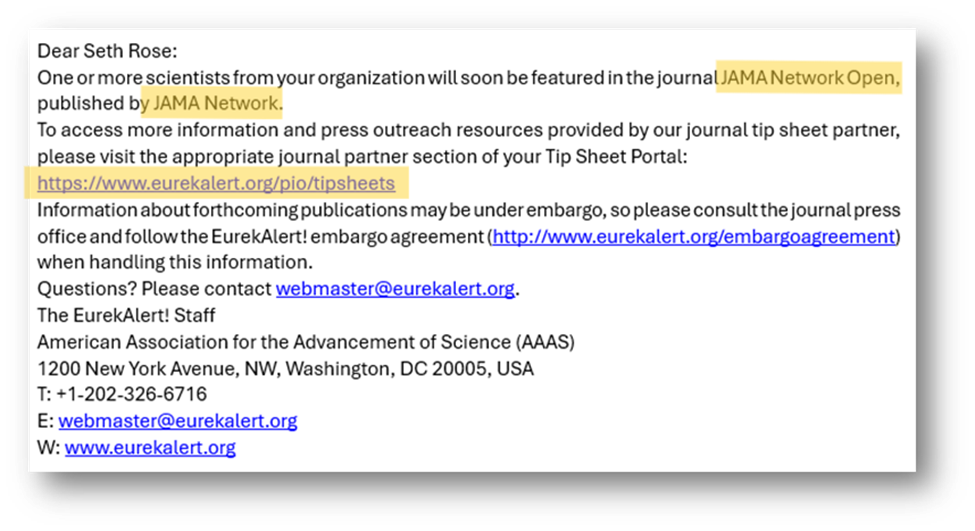
The tip sheet notification email template does not include individual article specifics such as author names, links to the exact tip sheet portal or article, study title, and so forth. While some PIO-members ask to have these additional details in the email notifications, it is not possible because of the embargoed status of most articles and EurekAlert!’s obligation to journal publishers to ensure the security and proper distribution of their content, which we can only do by having PIO-members log in to on the platform.
The table below lists each publisher currently using the tip sheet service and how PIOs can obtain a copy of the article. Contact information for each publisher is listed on their tip sheet portal (we kept it out of this post for anti-spam reasons). Please note that tip sheet information is archived for a maximum of six months.
| American Association for the Advancement of Science (Science family of journals) | Rockefeller University Press (RUP) |
| Papers made available?: Yes, as downloadable PDF files | Papers made available?: No, must contact journal press office |
| Embargoed?: Yes | Embargoed?: Yes |
| Cell Press | Society for Neuroscience |
| Papers made available?: Yes, as downloadable PDF files | Papers made available?: No, must contact journal press office |
| Embargoed?: Yes | Embargoed: No |
| PNAS | American Chemical Society |
| Papers made available?: Yes, as downloadable PDF files | Papers made available?: Yes, as downloadable PDF files |
| Embargoed?: Mixed (small number of non-embargoed papers each week) | Embargoed?: Yes |
| JAMA Network | |
| Papers made available?: No, must contact journal press office | |
| Embargoed?: Yes |