
By Brian Lin, Director of EurekAlert!
EurekAlert! is science news release distribution platform operated by the American Association for the Advancement of Science (AAAS). In addition to being the publisher of the Science family of journals, AAAS supports a range of initiatives that advance science communication and public engagement, including EurekAlert!.
Celebrating its 30th anniversary this year, EurekAlert!’s mission is to make science news more accessible to journalists and the public alike.
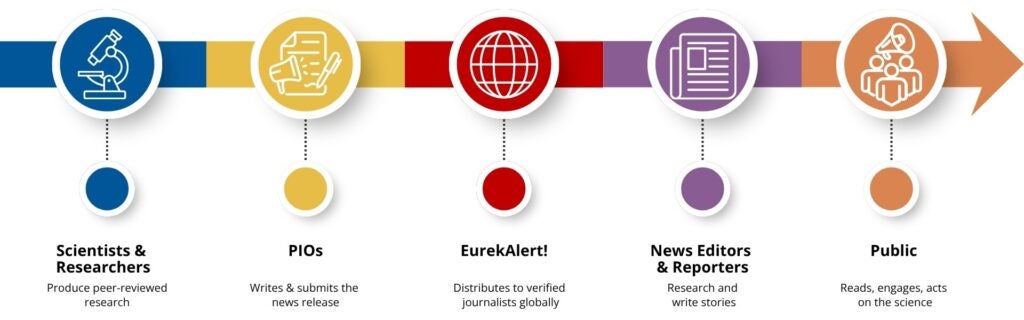
So, what does that communication workflow look like?
It starts with scientists and researchers who produce peer-reviewed research. PIOs help communicate that work by writing and distributing news releases. EurekAlert! sits at the center of this process, helping connect research with verified journalists around the world. News editors and reporters use EurekAlert! to discover new research and identify potential stories. Their reporting then helps bring that research to the broader public.
Connecting research with journalists worldwide
Today, more than 14,000 vetted journalists across 100+ countries use EurekAlert!, and many use it regularly to find science news and story ideas.
In a 2025 survey of EurekAlert! journalist members, 70% said they visit EurekAlert! multiple times a week, while 60% reported writing new stories based on ideas they identified on EurekAlert! multiple times a month. Embargoed access is a crucial part of how journalists use the platform: In the survey, 78% said the embargoed news feed is very valuable and 73% an embargo affects their decision to cover a story. When asked about timing, 83% said three to seven days is a reasonable embargo period.
What independent research says about EurekAlert!
Peer-reviewed studies have demonstrated EurekAlert!’s role in enhancing the societal impact of the scientific enterprise through science communication, particularly through facilitating media coverage.
A 2023 study from researchers at Leiden University analyzed more than 455,000 EurekAlert! news releases up to 2021. It found that 66.2% of EurekAlert! news releases included a DOI, providing a direct connection to the peer-reviewed papers. It also found that 79% were linked to by webpages, including news sites and blogs; while 57% had been shared on Twitter (now X). The study also offers a glimpse into the types of research being communicated through the platform, with 41% of the news releases focused on medicine or health, as well as how the platform helps further amplify research elsewhere online.
A 2025 Science Advances study of more than 1,000 archaeology papers shows that studies with news releases on EurekAlert! were 4 times more likely to receive news coverage from the top 15 U.S. media outlets, compared with those without a EurekAlert! news release. 70% of papers with a EurekAlert! news release received coverage, compared with 22% of those without.
Our own data shows that the United States is still the largest contributor of news releases by volume, accounting for roughly half of the ~30,000/year submissions, followed by China, the United Kingdom, Germany and Japan. It’s worth noting that China overtook the U.K. as the second largest submitter to EurekAlert! in 2024, as Asia overtook Europe in a similar timeframe.
First to journalists, then the world
For PIOs using EurekAlert! to amplify their institution’s research, their primary audience on EurekAlert! are journalists. Here’s where our journalist members are located:
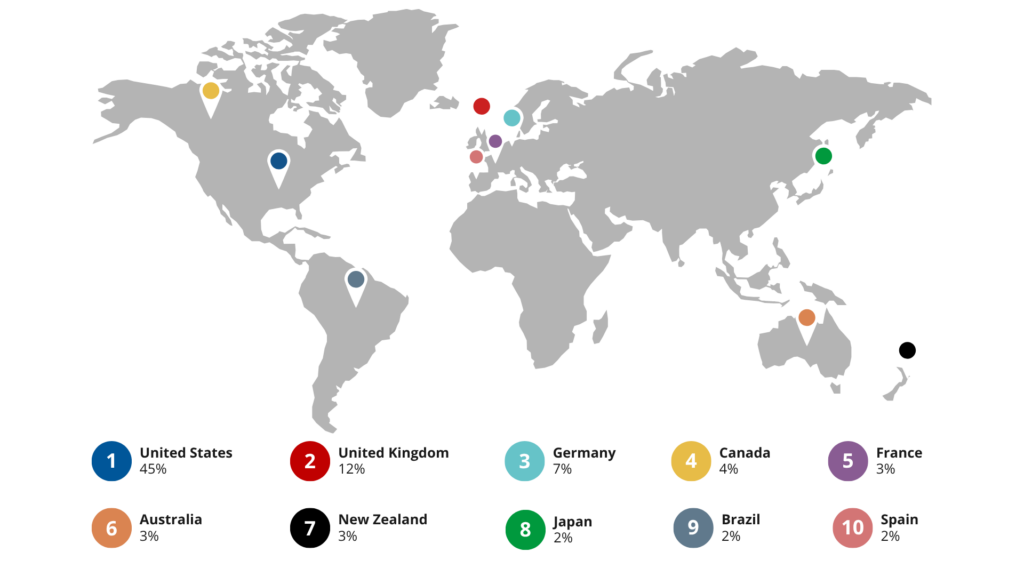
- United States: 45%
- United Kingdom: 12%
- Germany: 7%
- Canada: 4%
- France: 3%
- Australia & New Zealand: 3%
- Spain, Italy, Brazil, & Japan: 2% each
- Other countries: 18%
Many PIOs tell us that their secondary goal for using EurekAlert! is to increase discoverability of their content, since all news releases on EurekAlert! are freely available.
So far this year (January-August 2026), EurekAlert! has received 6.39 M total visits from 4.46 M unique visitors, generating 10.24 M total page views.
Visitors find EurekAlert! in a variety of ways, but three stand out:
- Direct visits: 46% of traffic comes from direct visits, meaning many visitors come directly to EurekAlert! by typing in the website address or using a bookmark, suggesting that EurekAlert! is a destination they already know and seek out.
- Search engines: 37% of traffic comes through search engines. People searching for science news and research can discover EurekAlert! news releases in their search results, making search an important way for new audiences to find research shared on the platform.
- AI tools: 1.1% of traffic now comes through AI tools, and we are seeing a growing number of visitors arrive through platforms such as ChatGPT, Gemini, Perplexity, Claude and Copilot.
These numbers show that EurekAlert! is a destination that people intentionally seek out or through the tools they use to search for information online.
Looking more closely at total page views: the United States accounts for nearly half of all views, and visitors. The top 10 countries by share of page views are:
- United States: 48.8%
- United Kingdom: 8.0%
- Brazil: 6.1%
- India: 6.0%
- Japan: 5.6%
- Germany: 5.5%
- China: 5.1%
- Canada: 4.4%
- Spain: 2.8%
- France: 2.8%
Data-driven insights
As PIOs who use EurekAlert! to amplify their institution’s research, this data suggests that:
- The US is still the largest supplier of content AND consumer of content. This has been consistent throughout EurekAlert!’s history and good news for those who aim for U.S. media coverage and U.S. public audiences.
- Increasing competition from sources in Asia in terms of volume, particularly from China-based institutions and publishers. The former will focus on China-based research and scientists while the latter may feature articles with authors worldwide.
- Journalists’ preferences and needs have not changed: they’re still looking for breaking news (especially if they can get their hands on it during embargo), strong connections to their audiences, and fast and easy ways to help them determine if a piece of news is worth their time.
While EurekAlert! can help science reach a wider audience in general, the way research is communicated can make a big difference in whether a story catches a journalist’s attention. So, what can you do to help your news releases stand out?
Four keys to a strong news release
With thousands of news releases competing for journalists’ attention, how you communicate your research matters. Here are some tips to keep in mind:
- A news release is not a journal abstract: Start with one clear message: Why does this research matter to readers?
- Use engaging multimedia to help tell a story: Journalists want what their readers want. Strong images can help attract attention to your story, while infographics and short videos can make complex research easier to understand
- Write clear headlines, use strong quotes, and add a human voice: Keep your headline short and clear. Strong quotes from the researcher make the story feel personal and easy to read.
- Send it at the right time: Submit your news release on or shortly before the research is published, and connect the research to timely topics or conversations already happening in the news.
Want to know what makes a news release stand out to our team? Check out What makes a good news release? for more tips and examples.